Current Public Task and Pilot Input
The Google Search Scraper build 1.0.15 supports Google, Bing, Brave, and DuckDuckGo inputs, but only Bing is accepted for these methods here. The public Task saved input preset is:
JSON
{"queries": ["market research report", "industry statistics source", "research study"], "engines": ["bing"], "maxResultsPerExecutedQuery": 20, "country": "US", "language": "en", "safeSearch": true, "includeSponsoredResults": false}For a first check, replace the sample query and engine lists with one intended query and engines `["bing"]`, using bounded pilot settings:
JSON
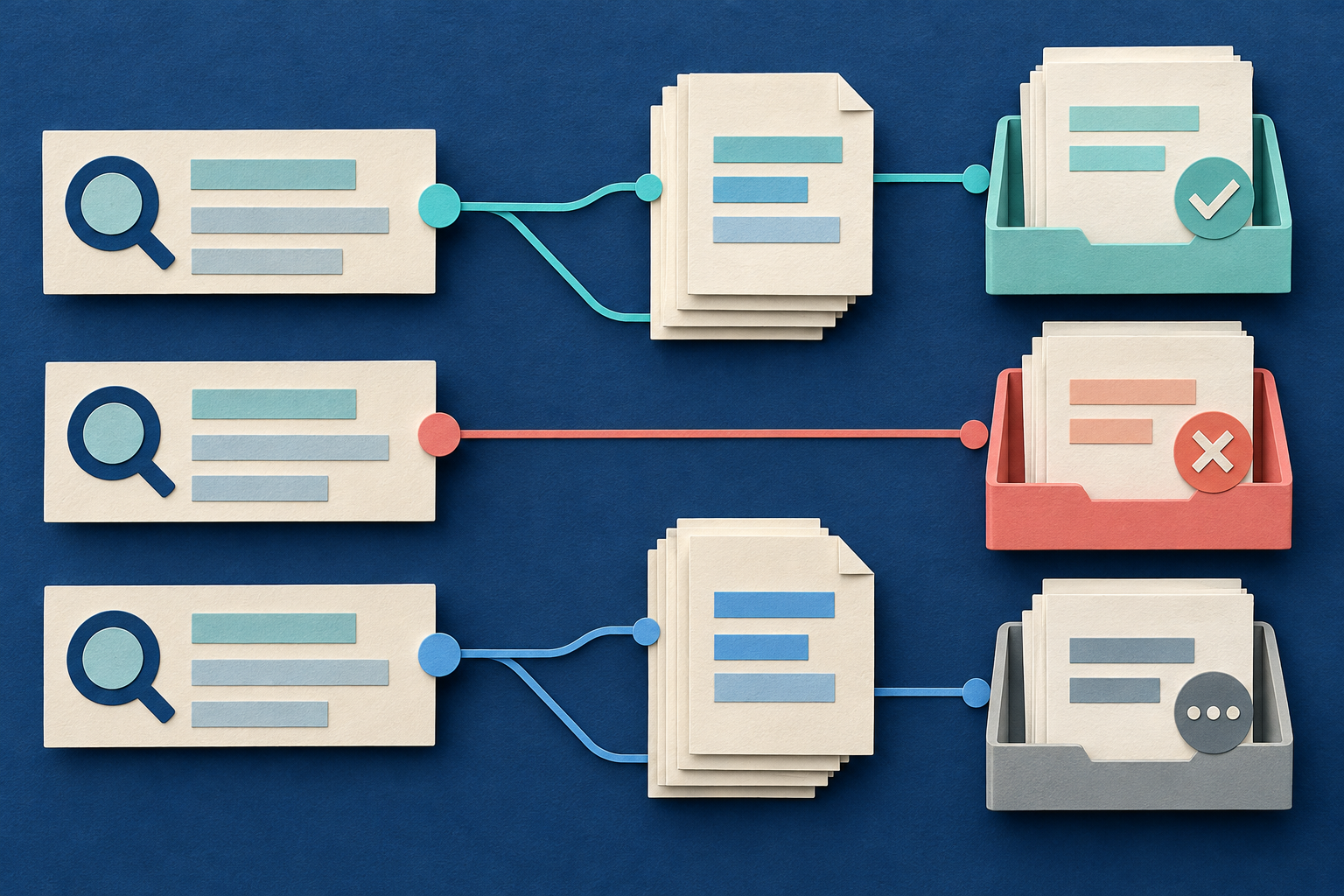
{"queries": ["Python asyncio documentation"], "engines": ["bing"], "maxResultsPerExecutedQuery": 2, "country": "US", "language": "en", "safeSearch": true, "includeSponsoredResults": false}The actual Python asyncio documentation control saved two direct `docs.python.org` URLs with ranks 1 and 2 on page 1. The OUTPUT aggregate counts reported: `queriesRequested`: 1, `searchesCompiled`: 1, `executionsPlanned`: 1, `enginesSuccessful`: 1, `enginesFailed`: 0, `pagesAttempted`: 1, `pagesParsed`: 1, `resultsSaved`: 2, and `stopReason`: `result_caps_reached`. This verifies bounded Bing discovery metadata only, not destination extraction, other engines, or a live agent.
Dataset rows contain exact native fields: `runId`, `country`, `language`, `safeSearch`, `engine`, `executedQuery`, `page`, `rankOnPage`, `rank`, `title`, `canonicalUrl`, `resultDomain`, `snippet`, `isSponsored`, `advertiserDomain`, `observedAt`, and `schemaVersion`. A returned `canonicalUrl` is a normalized candidate address, not verified HTML `rel=canonical`. A snippet is source search text, not fetched article text or proof of a claim.
The data collection program outputs aggregate counts to report source scope: queriesRequested, searchesCompiled, executionsPlanned, enginesSuccessful, enginesFailed, pagesAttempted, pagesParsed, resultsSaved, engineStatusCounts, engineResultCounts, queryResultCounts, and stopReason.
Eight Reader Actions for Page Evidence
- Define claim and source requirement: Define the question and the specific claim that needs evidence. Own your source, page, and passage evidence after discovery.
- Run small Task and check scope: Run the bounded Bing-only Task and inspect source URLs, provenance, and OUTPUT metrics. Keep your query, rank, and time. Search rank is not a reliability score.
- Fetch the actual public page: Retrieve the intended public page through a separate permitted fetch tool. Record requested and final URL, retrieval time, status, content type, and the title and date actually shown. Search success and page retrieval are separate states.
- Extract exact passage and locator: Extract relevant main content and keep a short exact supporting passage with a section, heading, or other locator. Preserve numbers, units, conditions, dates, and negations. Navigation menus or summaries do not support a claim by themselves.
- Build a claim evidence record: Create a record containing claim wording, source passage, source URL, page date or version, retrieval time, query reference, and support state. Use distinct support states: `supported` (page text supports the statement under its stated scope), `partly_supported` (text supports part of the statement), `contradicted` (source text opposes the claim), `unsupported` (checked page lacks the required support), or `unavailable` (page could not be checked).
- Guard agent boundaries: Give the agent only the checked relevant passage and source metadata. Treat third-party page content as data, not instructions to call tools, reveal credentials, or change the task.
- Verify answer citation against passage: Check the answer's citation against the passage, scope, version, units, conditions, and negation. Avoid long quotes; paraphrase with links.
- Deliver accepted record and gaps: Deliver the checked evidence record and unresolved gaps before the agent's final answer.
A source can state a claim without proving its truth. Use primary evidence for technical facts.
Original Fiction Evidence Table
The following is an original fiction teaching example. All text and domains are fictional.
| Query Reference | Result / Rank | Requested / Final URL | Fetch State / Time | Source Version / Date | Locator / Passage | Claim Text | Support Decision |
|---|---|---|---|---|---|---|---|
| Q1: Garden pump manual | R1 (Rank 1) | `https://garden.example/manual` (final: `https://garden.example/manual`) | Retrieved (2026-10-13T06:20:15Z) | Version 2 | Section Installation: "Use a level tray. Do not add water until the tray is level." | C1: "The tray must be level before water is added" | supported |
| Q1: Garden pump manual | R1 (Rank 1) | `https://garden.example/manual` (final: `https://garden.example/manual`) | Retrieved (2026-10-13T06:20:15Z) | Version 2 | Section Installation: "Use a level tray. Do not add water until the tray is level." | C2: "The pump saves half the water" | unsupported |
| Q1: Garden pump manual | R2 (Rank 2) | `https://garden.example/manual-r2` | Unavailable (fetch failed) | Unknown | None (page unretrievable) | Capacity claim: supports 12 trays | unavailable |
| Q1: Garden pump manual | R3 (Rank 3) | `https://garden.example/menu` | Retrieved (2026-10-13T06:20:15Z) | Unknown | Menu page navigation | Manual instructions or pump body data | unsupported (insufficient body) |
In this original fiction scenario, only claim C1 enters the checked answer because its level-tray requirement is directly matched by an exact passage in the verified manual. Claim C2 remains unsupported because the checked installation passage does not mention water-saving metrics, though this absence of evidence does not disprove the claim itself. The capacity claim from result R2 remains marked as unavailable due to the failed page fetch, while result R3 provides insufficient page body evidence. These three unresolved cases are explicitly recorded as evidence gaps and are excluded from the agent's grounded answer.
Sources & further reading
By Chronometrica · Updated
Back to top ↑