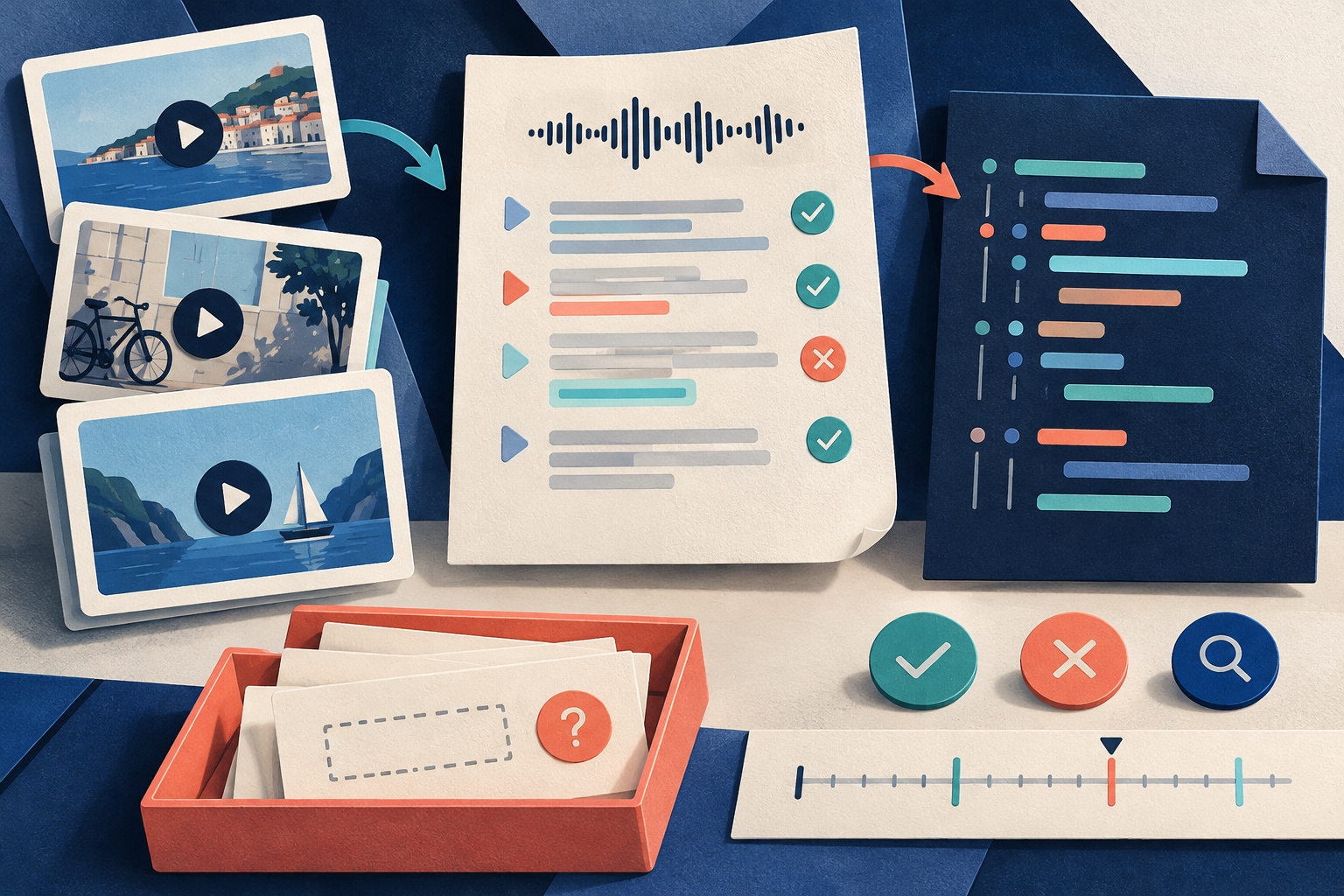
This choice matters before you build a transcript table. A study of captions examines text already exposed by the platform. A study of speech may need text created from the audio. Those sources can support different research questions, even when they concern the same video.
Here, native captions means the caption track already exposed by TikTok. It does not mean that a person wrote it. TikTok captions may already be automatic. Speech-to-text means software that creates words from audio.
The research need is concrete. A researcher asking about TikTok transcripts for quantitative content analysis also asked whether built-in captions were available or a speech-to-text tool was needed. That question supports choosing the text source first. It does not establish accuracy, completeness, or permission for a particular study. Research question
The useful result is a written source rule, a list of source-linked records, and separate states for existing captions, missing captions, and newly generated text.
Decide which words belong in the study
Start with the research object: the thing your study aims to examine. Then state which text sources can represent it.
If you study platform captions themselves, the existing caption track is part of the evidence. Its wording, language, and absence matter. A new transcript may help you understand a video, but it cannot replace a missing caption track in that analysis.
If you study spoken words, new speech-to-text may be an allowed source. You still need to decide whether the study will use generated text throughout or only for selected cases. Write that rule before you see which videos lack captions.
Translation is a separate choice. It changes the language of the text that you code. A rule that allows new transcription does not also have to allow translation. Likewise, a request for an English caption track does not mean a request to translate another track into English.
Write a short policy that answers four questions:
- Are we studying existing captions or spoken audio?
- May software create a new transcript?
- Which languages qualify, and is translation allowed?
- What will we report when usable text is unavailable?
Keep this policy with the study records. It gives each later decision a clear basis. It also prevents a practical collection choice from changing the research question without a record.
A narrow rule can be useful. A study that requires existing English captions may accept fewer videos for text analysis. That can be the correct result for its question. More available text is useful only when it remains valid evidence under the declared rule.
Compare the two Actors by their checked fit
An Actor is a hosted data collection program. These two Actors offer different routes to video text. The public product contracts used here were checked on 20 October 2026. No matched test of word accuracy, timing accuracy, cost, scale, or reliability was made.
| Decision point | Chronometrica | SIÁN |
|---|---|---|
| Text source | Existing public caption tracks | New AI speech-to-text |
| Video input | `startUrls`, with 1–100 public links, short links, or video IDs | Single `tiktokUrl` or `bulkUrls` list |
| Timing | Caption segments with start and end times | Word-level timestamps |
| Other documented features | Explicit caption and language result states | Speaker labels, SRT/VTT output, optional English translation |
The table describes documented contracts. It does not establish that an undocumented feature is absent. Chronometrica contract, Chronometrica input, SIÁN contract, SIÁN input
Chronometrica is a strong fit when preserving the platform-caption method is the goal. It reads existing public tracks and reports explicit outcomes when captions or a requested language are unavailable. It does not generate speech-to-text, download audio for transcription, or translate text. That is the main limit that changes the recommendation. Chronometrica contract
Choose from the research rule first. File format and later table preparation come after that choice.
Define the sample and create a source ledger
A sample is the set of videos selected for the study. A ledger is a table that records those inputs and what happened to each one.
Define the sample before collection. Record the reason each video belongs in it. Use a stable video identifier where available, and retain the submitted link. This helps you detect repeated inputs without losing their history.
Set the language rule at the same time. An English-only study needs a different rule from a multilingual study. For the latter, state which original languages qualify and how researchers will review them. Do not let the language of a short input example become the study policy by accident.
Keep the original text, language, source URL, and observation time with each text record. Keep unknown values unknown. Do not replace a missing duration, language, or other value with zero.
Add a reader-owned field such as `text_source` to your research ledger. Use values such as `platform_caption` and `new_speech_to_text`. This field belongs to your ledger; it is not a native Chronometrica output field.
For records with no text, retain the result state and reason. Do not assign a text source that was never collected. If you later add a generated transcript, keep its source and collection record separate from the earlier missing-caption result.
Keep translations separate from original-language text as well. A researcher should be able to tell which words were collected, which were generated from audio, and which were translated.
This structure lets you change an allowed collection step without rewriting the history of the evidence. It also gives a reviewer enough information to trace a coded passage back to its video and text source.
Check a small list before collecting the full sample
Use a small, known list to check that the input and output support your policy. Include relevant permitted study videos. The purpose is to inspect actual result states and text before you commit to the full collection.
Chronometrica accepts a language preference through `preferredLanguages`. If the requested language is unavailable, it returns a status instead of substituting or translating a track. Input schema
The following input was checked against the public schema. It was not run. The public video appears in the schema example and saved Task. Its current caption availability is unknown. Replace it with a relevant permitted study video.
{
  "startUrls": [
    "https://www.tiktok.com/@hankgreen1/video/7047596209028074758"
  ],
  "preferredLanguages": [
    "en"
  ]
}This input requests English captions. It does not request an English translation. Preserve `language_unavailable` if the requested caption language is unavailable. Input schema
A Task is a saved input preset. The public content-analysis dataset Task provides a starting point for this route. Its existence does not establish that a particular video currently has captions.
Inspect the first results against your written rule. Confirm that you can retain missing cases, identify repeated inputs, and connect usable text to its source. Resolve any mismatch in your ledger design before expanding the collection. A larger batch cannot correct an unclear definition of eligible text.
Reconcile every result before calculating availability
Chronometrica returns a result row for each submitted video input. The row includes input references, video details, language, text, caption segments, status, status reason, billing state, and collection time. Its batch summary is named `OUTPUT`. Actor contract
Use `inputIndex` and `inputUrl` to connect a row to the submitted list. Retain `videoId` and `videoUrl` when available. Keep `languageCode` and `scrapedAt` with the text. Successful `segments` contain `startSeconds`, `endSeconds`, and `text`. These fields preserve the reported caption intervals. Actor contract
Read `status` and `statusReason` before treating a row as usable text. Relevant explicit states include `succeeded`, `no_public_captions`, `language_unavailable`, and `duplicate_input`. Other inaccessible or failed outcomes remain distinct. Actor contract
Use this short check:
- Match each result row to a submitted input.
- Count results by status and compare them with `OUTPUT`.
- Identify duplicate submissions and the distinct videos they refer to.
- Apply the declared language and text-source rules.
- Retain all unresolved cases with their actual reasons.
- Calculate availability using the declared distinct-video count.
The denominator is the total used at the bottom of a fraction. For text availability, use the number of distinct videos in the declared sample. Do not shrink it to include only videos that returned usable text.
Duplicate submissions need care. Preserve their rows for collection checks, but do not count the same video twice when the study unit is one distinct video.
A missing-caption row is not an empty successful transcript. Preserve that distinction before calculating word counts or coding themes. Otherwise, unavailable text could be mistaken for a video with nothing to say.
Work through a fictional eight-video study
The following is a fictional study example. These counts are not collection results, a benchmark, or a customer outcome.
The study defines eight distinct video inputs. Its initial rule requires existing English platform captions. Five videos have usable matching captions. Two resolve but have no public caption track. One has captions only in another language.
Under that rule, native-caption availability is:
5 / 8 × 100 = 62.5%.
Three videos lack eligible text. Keep their reasons separate: two have no public caption track, while one lacks the requested language. A single unavailable count is useful for the total, but it does not explain those different outcomes.
Now suppose the study permits new English speech-to-text for the two captionless videos. The policy still leaves the other-language case unresolved. With text for seven videos, availability under the mixed method becomes:
7 / 8 × 100 = 87.5%.
The change in text availability is:
87.5 − 62.5 = 25 percentage points.
Native-caption availability remains 62.5%. The two generated transcripts did not become platform captions. The 25-point change describes text availability under a broader method. It does not describe an accuracy gain.
In the ledger, mark the five caption records as `platform_caption`. Mark the two generated records as `new_speech_to_text`. Retain the earlier captionless outcomes so the record still explains why generation was used.
If the study examines platform captions, analyze the five eligible native records and report the three unavailable cases. If it examines spoken words and permits generation, SIÁN may fit the added transcription stage. SIÁN contract
Neither choice proves that missing-caption videos share a political view or another trait. The example also does not establish that either method is unbiased. It shows how the source rule changes the eligible text while the original sample stays fixed.
Audit the words before content analysis
Content analysis uses stated rules to classify text. Researchers often call this step coding. Before coding, check selected passages against the video.
Listen to the passage and compare its words with the text record. Check names, numbers, negation, and terms that affect the planned categories. For example, losing the word “not” can reverse the meaning of a sentence.
Check selected times as well. Confirm that the recorded interval points to the relevant passage. A successful data read does not prove that every word or time is correct.
Apply a stated review process to each allowed text source. Record which passages were checked and how corrections were handled. If you correct text, retain the collected version and identify the corrected version used for coding. This keeps the source record available for review.
For translated text, retain the original words and identify the translated version. Do not silently combine them into one text field. The report should make clear which version supplied the coded words.
Then prepare the analysis table. The TikTok thesis transcript guide covers that next stage. The choice in this comparison comes first: decide which text belongs in the study before organizing it for analysis.
In the report, state the sample definition, language policy, permitted sources, and treatment of missing cases. Give the eligible count against the full declared denominator. If you use a mixed method, report native-caption availability separately from total text availability.
Carry unresolved cases into the report. Readers need to see where text was unavailable and how that limits the analysis. A clear account of missing evidence is part of the result.
Sources & further reading
By Chronometrica · Updated
Back to top ↑